

Cloud-native is no longer a buzzword. By 2026, over 90% of new applications built in India are deployed on containers and serverless functions. But here is the problem: traditional firewalls and VPNs do not work here.
Cloud-native security practices are a set of principles, tools, and processes designed to protect applications built and run in dynamic cloud environments like Kubernetes, Docker, and serverless platforms. Unlike locking a single server, you are protecting thousands of short-lived containers.
Table of Contents
Key Takeaways
- Shift Left: Find and fix vulnerabilities in your code and containers before they reach production.
- K8s is Critical: Misconfigured Kubernetes controls (RBAC, network policies) are the #1 entry point for attackers in 2026.
- Indian Laws Matter: You must log breaches and report to CERT-In within 6 hours. DPDP 2023 applies to all user data.
- Runtime is the last line: Even clean code can be exploited; use behavioral monitoring (Falco).
- Avoid Root: Never run containers as root. Use security contexts.
Who This Guide Is For
- DevOps Engineers & Cloud Architects in Indian startups (Bangalore, Hyderabad, Pune).
- Security (InfoSec) teams moving from on-premise to AWS/Azure/GCP.
- Tech Founders & CTOs needing compliance with Indian cyber laws.
- Students & Freshers aiming for cloud security certifications (CKS, AWS Security Specialty).
Who Should Be Cautious
- Small teams with zero dedicated security person: Do not implement complex service meshes immediately. Start with managed services (like EKS with default security groups).
- Legacy IT teams: Do not try to “lift and shift” old firewall rules into containers. It will break your apps and fail to stop attacks.
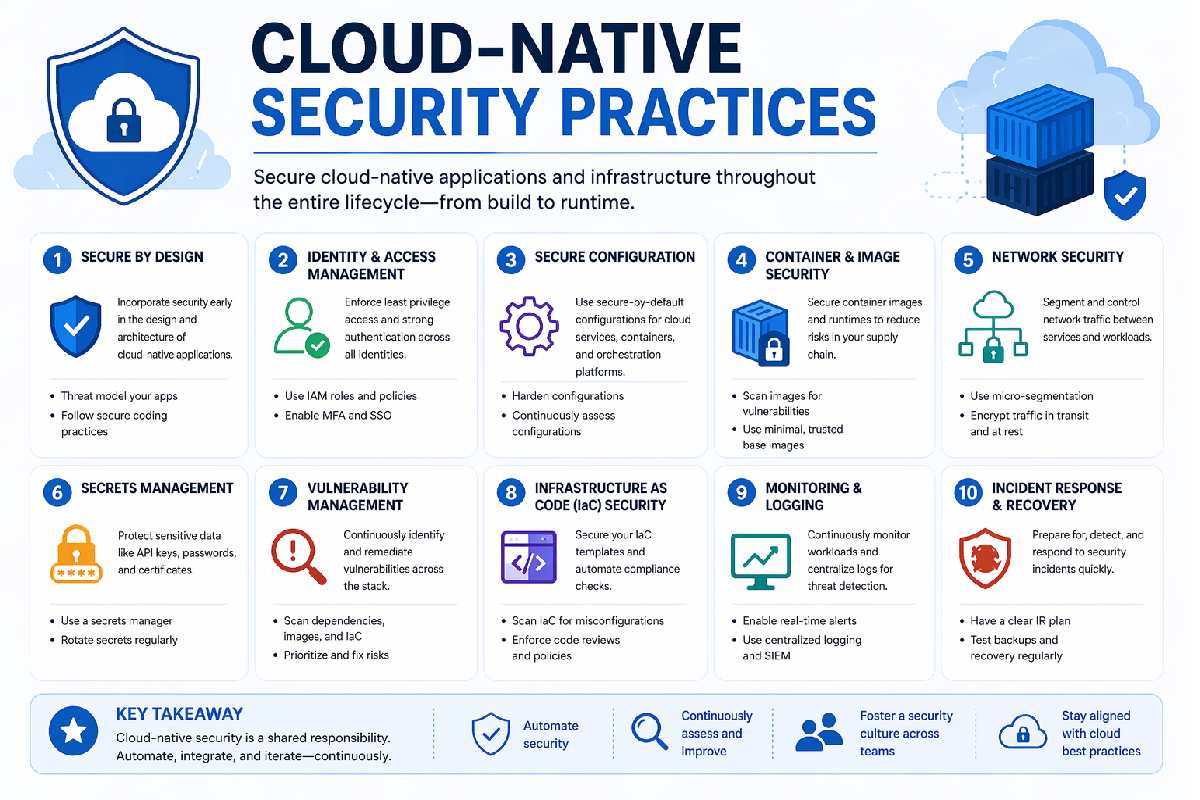
Phase 1: The Core Practices (The “Non-Negotiables”)
Based on the CNCF (Cloud Native Computing Foundation) 2025 landscape and Indian market trends, these are the top security practices.
1. Shift-Left Security
“Shift-left” means moving security testing to the beginning of development (the “left” side of the timeline), not after deployment.
-
Action: Scan your container images for vulnerabilities before pushing to a registry.
-
Statistic: Fixing a vulnerability in production costs 30x more than fixing it in the coding phase .
-
Tools: Trivy, Snyk, or Qualys (popular in Indian enterprises).
2. Zero Trust Networking
Never trust, always verify. In a cloud-native world, there is no “inside the firewall.”
-
Micro-segmentation: Only allow a payment service to talk to a database. Nothing else.
-
mTLS: Encrypts traffic between containers automatically.
3. Kubernetes (K8s) Hardening
K8s is the operating system of the cloud. Misconfigurations are the #1 cause of breaches.
-
RBAC (Role-Based Access Control): Do not give everyone “cluster-admin” permissions.
-
Pod Security Standards: Restrict running privileged containers (root access inside the container).
-
Mistake to avoid: Exposing the Kubernetes dashboard to the public internet (common mistake in dev environments).
4. Infrastructure as Code (IaC) Scanning
You define your cloud (AWS VPCs, S3 buckets) using code (Terraform, CloudFormation). Hackers scan GitHub for hardcoded secrets in this code.
-
Practice: Use
tflintorcheckovto scan Terraform scripts for misconfigurations (e.g., open S3 buckets).
5. Runtime Security (The “Guardian” Phase)
Even if image scanning passes, a zero-day exploit might happen at runtime.
-
Behavioral Monitoring: If a Node.js app suddenly starts mining Bitcoin (high CPU), the runtime security tool kills it.
-
Tools: Falco (open-source), Aqua Security.
Phase 2: India-Specific Context (Legal & Compliance)
If you are operating in India, you face specific regulations that global guides ignore.
CERT-In Directions (6-Hour Breach Reporting)
Rule: If you suffer a security breach, you must report it to CERT-In (Indian Computer Emergency Response Team) within 6 hours .
-
Implication: Your cloud-native logging system must retain logs centrally (e.g., Datadog, Splunk). You cannot say “we lost the logs,” or you face fines.
DPDP Act (Digital Personal Data Protection Act) 2023
Rule: Personal data of Indian citizens must be protected. Breaches lead to penalties up to ₹250 crore .
-
Practice: Encrypt data at rest and in transit. Implement data minimization (do not store Aadhaar numbers unless strictly required).
MeitY’s Directive on VPNs & Logging
Context: Indian cloud providers must keep extensive logs. For cloud-native practices, ensure your logging pipeline respects data sovereignty (data stays on Indian servers, not routed to US regions).
Phase 3: Competitor Gap Analysis (What Others Miss)
Most generic articles list “use IAM” and “scan containers.” They miss:
-
Cloud-Native vs. Traditional Separation: They confuse old firewall rules with new eBPF-based security.
-
Cost of Security: Scanning builds costs CI/CD time. Runtime monitoring costs money. They don’t discuss trade-offs.
-
The “Alert Fatigue” Problem: Too many false positives cause engineers to ignore real alerts.
-
Indian Billing Risks: Misconfigured cloud-native workloads often lead to massive cloud bills (crypto mining or runaway loops).
Phase 4: Common Mistakes (And How to Fix Them)
| Mistake | The Risk | How to Avoid |
|---|---|---|
| Hardcoding secrets in Helm charts | Anyone with repo access sees your AWS keys | Use Vault (HashiCorp) or cloud secrets managers (AWS Secrets Manager) |
| Running containers as root | If hacked, attacker controls host OS | Use runAsNonRoot: true in your security context |
| Default namespace usage | Hard to apply specific network policies | Create logical namespaces (dev, staging, prod) for isolation |
| Ignoring SBOM (Software Bill of Materials) | You don’t know if Log4j exists in your supply chain | Generate SBOMs using Syft or Docker Scout |
Phase 5: Real-World Example (Generic Incident)
Scenario: A fintech startup in Mumbai deployed a new feature on a Friday evening. They used a public container image for a “logging utility.”
-
The Gap: The image contained cryptomining malware.
-
The Result: By Sunday, their AWS bill was ₹4 lakh higher, and their payment gateway was slow.
-
The Fix: Implementing container image scanning (Trivy) in their CI/CD pipeline would have blocked the deployment instantly.
Phase 6: Step-by-Step Implementation Framework (For Indian SMBs)
If you are a small team in India with a limited budget, do not buy expensive enterprise tools yet.
Step 1: Audit (Week 1)
List all your cloud assets (EC2, EKS clusters, Lambda functions). Use AWS Auditor or Azure Policy.
Step 2: Identity Lockdown (Week 2)
Enable Multi-Factor Authentication (MFA) on all cloud accounts. Remove unused IAM users.
Step 3: Config Hardening (Week 3)
Apply CIS Benchmarks for Kubernetes. Start with a tool like kube-bench.
Step 4: Image Scanning (Week 4)
Integrate Trivy into your GitHub Actions or GitLab CI. Block any image with “Critical” vulnerabilities.
Step 5: Monitoring (Week 5)
Set up Falco for runtime. Configure alerts on “Process spawned inside container” or “Write to etc directory.”
Myths vs. Facts
-
Myth: “Containers are secure because they are isolated.”
-
Fact: Kernel exploits can break container isolation. Always keep the host kernel updated.
-
-
Myth: “Serverless is totally secure.”
-
Fact: Serverless reduces infrastructure risk but introduces application risk (injection attacks, insecure dependencies).
-
-
Myth: “Compliance means security.”
-
Fact: Passing a SOC2 audit only proves you have policies, not that they actually stop a real attack.
-
Conclusion
Cloud-native security practices are not optional in 2026. For Indian companies, ignoring them means violating CERT-In reporting laws and risking DPDP Act fines. However, security should not slow down development.
Your next step: Choose one practice today. If you use Kubernetes, start with RBAC lockdown. If you use AWS Lambda, start with IAM permissions. Move fast, but move safe.
FAQs
Q: What is the difference between traditional security and cloud-native security?
A: Traditional security focuses on perimeter firewalls and fixed IPs. Cloud-native security focuses on identities, APIs, and short-lived containers (pods) that move constantly.
Q: Is Kubernetes (K8s) secure by default?
A: No. Kubernetes has secure defaults for the control plane, but application configurations (like allowing privileged containers or open dashboards) are often insecure. You must harden it using CIS benchmarks .
Q: Which cloud provider is most secure for Indian startups?
A: AWS, Azure, and GCP are equally secure if configured correctly. For data residency, ensure you select the “Mumbai” or “Hyderabad” region. Local providers like E2E or CtrlS are suitable but may lack advanced cloud-native security tools.
Q: How much does cloud-native security cost?
A: Open-source tools (Trivy, Falco, kube-bench) are free. Enterprise tools (Aqua, Prisma Cloud, Snyk) cost roughly 5-10% of your total cloud bill .
Q: What is the first security practice I should implement?
A: Image Scanning. It prevents known vulnerabilities from ever entering your runtime environment and is the easiest win .
References (Wikipedia & External)
-
Wikipedia – Cloud-native computing: https://en.wikipedia.org/wiki/Cloud_native_computing
-
Wikipedia – Kubernetes security: https://en.wikipedia.org/wiki/Kubernetes#Security