

Table of Contents
Quick Summary
As artificial intelligence initiatives become central to business strategy, traditional project management methods often struggle with unpredictable data lifecycles. Earning the CPMAI Certification equips you with a specialized, data-centric framework that drastically reduces project failure rates and bridges the gap between business and technical teams. This industry-recognized credential not only future-proofs your career but also unlocks high-paying leadership roles with an estimated salary premium of up to 31%. Master this structured methodology today to confidently lead high-impact AI initiatives and stand out in a competitive job market.
Introduction
Project management is undergoing a massive shift as artificial intelligence (AI) and machine learning (ML) initiatives become central to organizational strategy. Traditional project management methodologies often fall short when applied to the unique, iterative, and data-centric lifecycle of AI projects, leading to high failure rates. To stand out and successfully deliver these complex initiatives, you need a specialized framework designed for the realities of data science. Obtaining the CPMAI Certification (Cognitive Project Management for AI) equips you with the exact methodology needed to lead these high-stakes projects to success.
This article breaks down the top 10 benefits of earning your CPMAI Certification in 2026, showing you how it can boost your earning potential, future-proof your career, and give you a competitive edge. We will also compare this credential to traditional certifications like PMP and Agile, helping you decide if this investment is the right step for your career path. Read on to discover how mastering this specialized framework can position you as a highly sought-after leader in the rapidly growing field of AI project management.
Introduction to CPMAI Certification for Project Managers
What is Cognitive Project Management for AI (CPMAI)?
Cognitive Project Management for AI (CPMAI) is a specialized project management methodology designed to handle artificial intelligence and machine learning initiatives. It transforms traditional data science workflows into structured, step-by-step phases, enabling organizations to deliver reliable, high-performing cognitive solutions on time and within budget.
At its core, CPMAI is a methodology specifically built for the cognitive technology methodology. Traditional project management models were made for building tangible software or infrastructure where outputs are highly predictable. In contrast, AI systems rely on data, which is highly unpredictable. CPMAI fills this gap by utilizing a structured approach based on the well-known CRISP-DM (Cross Industry Standard Process for Data Mining) model. It refines this model to align with modern corporate environments, creating an agile ai framework that guarantees high-quality project delivery.
By learning this methodology, you gain a deep understanding of data science project management. You learn how to move projects through essential phases, including business understanding, data understanding, data preparation, model development, model evaluation, and operational deployment. This systematic method turns chaotic, experimental data experiments into highly predictable, repeatable, and scalable corporate processes.
Why Traditional Project Management Frameworks Fall Short for AI
Traditional project management frameworks fall short for AI because they assume requirements are fixed and predictable. Machine learning projects depend on uncertain data behavior, non-linear experimentation, and continuous model retraining, which standard waterfall or basic agile methods cannot adequately structure, track, or control.
In standard software development, programmers write explicit code to generate a specific, predictable output. If you build a shopping cart application, the math is straightforward, and the system behaves exactly the same way every time. Artificial intelligence projects do not work this way. Instead of writing rules, developers feed massive datasets to algorithms, which then learn to find patterns and write their own internal rules. This difference shifts the entire development cycle from construction to scientific discovery.
Because of this experimental nature, traditional project phases do not map well to the machine learning lifecycle. Software developers using classic Agile might build a features list and burn through tasks. However, in data science, a team might spend weeks cleaning a dataset only to discover that the data does not contain the patterns needed to train the model. Traditional frameworks view this as a major failure or scope delay. CPMAI, conversely, builds these discovery phases directly into its core path, ensuring that failures are caught early, inexpensively, and without disrupting the rest of the organization.
The 10 Key Benefits of CPMAI Certification
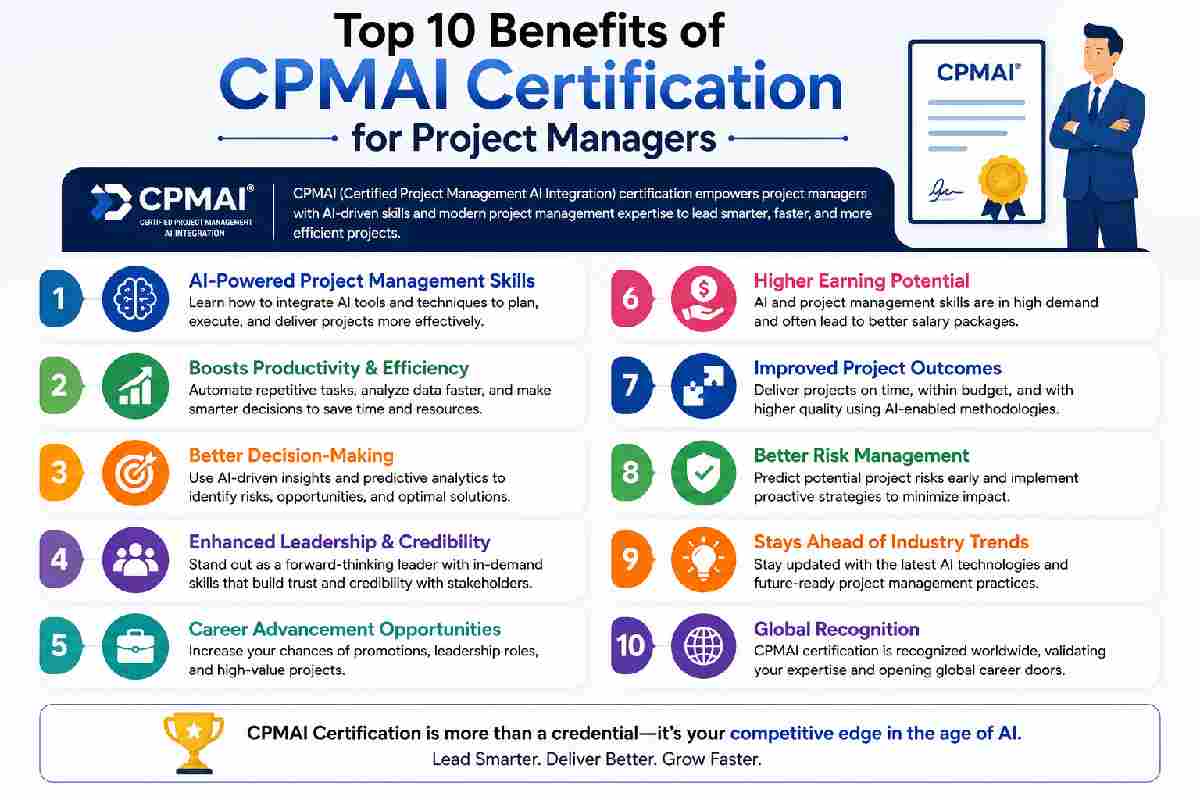
Earning a specialized credential in AI management offers immediate advantages to modern professionals. Below is an overview of the core benefits that this training provides to professionals and their organizations.
| Benefit Category | Core Objective | Impact on AI Projects |
| Methodology Mastery | Structured machine learning lifecycle | Reduces chaotic workflows and aligns development with corporate goals. |
| Financial Growth | Higher earning potential | Positions certified managers for highly paid leadership roles. |
| Risk Reduction | Controlled data readiness assessment | Prevents costly project failures and runaway scope creep. |
| Ethical Oversight | Trustworthy AI implementation | Builds bias mitigation and regulatory compliance into the model. |
1. Master a Specialized Methodology Designed Specifically for AI and ML
The machine learning lifecycle requires a non-linear approach that classical management systems simply cannot accommodate. By obtaining your CPMAI credential, you master a specialized, data-centric methodology. This framework provides step-by-step guidance tailored to the real-world iterative processes of data science, allowing you to manage model training, testing, and deployment cycles with complete confidence.
This specialized training changes how you view project progression. Instead of measuring success by completed lines of code, you learn to measure progress by data quality, model accuracy, and predictive value. You gain the ability to structure tasks so that data scientists and engineers can collaborate effectively without losing track of business objectives.
2. Increase Your Earning Potential and Marketability
As organizations rush to implement machine learning, the demand for certified professionals has skyrocketed. This certification is a strong signal to recruiters and hiring managers that you possess rare, highly valued skills. Consequently, certified professionals enjoy substantial salary advantages compared to general project managers.
The job market increasingly rewards specialized expertise over generalized knowledge. By adding this industry-recognized credential to your resume, you stand out during hiring processes and justify a premium salary. Companies are willing to pay more for leaders who can guarantee that expensive AI budgets will lead to actual, functioning systems.
| Role Title | Average Base Salary (Standard) | Average Salary with CPMAI Certification | Estimated Salary Premium |
| Project Manager | $95,000 | $125,000 | + 31% |
| Technical Project Manager | $115,000 | $145,000 | + 26% |
| Data Science Manager | $130,000 | $160,000 | + 23% |
3. Bridge the Gap Between Business Leaders and Technical Data Science Teams
A primary cause of artificial intelligence project failure is communication breakdown. Business leaders speak in terms of return on investment, market share, and operational efficiency. Technical teams, on the other hand, speak in terms of epochs, precision-recall curves, and gradient descent. This division often leads to misunderstandings and failed initiatives.
Through CPMAI training, you learn how to act as a highly effective translator. You will translate complex corporate goals into technical requirements that data scientists can build. At the same time, you will translate technical model performance metrics into business outcomes that senior executives can easily understand, ensuring long-term project support and clear alignment.
4. Minimize Project Failure Rates and Scope Creep
Many machine learning initiatives fail because they lack clear guardrails. Teams often start building models without validating data availability, leading to massive delays and blown budgets. CPMAI stops this by establishing strict evaluation gates at the end of every phase before more resources are spent.
By enforcing a structured phase-gate review, you can identify blockers early in the development lifecycle. If the business data is too messy or insufficient, the CPMAI framework forces you to address this issue before the expensive engineering phase begins. This control mechanism protects your project budget, reduces wasted labor, and prevents scope creep from sinking your initiatives.
5. Implement Ethical, Trustworthy, and Responsible AI Systems
Deploying predictive systems in the real world carries significant risks, including algorithmic bias, data privacy concerns, and regulatory compliance issues. Modern organizations cannot afford to deploy models that produce biased results or compromise sensitive user information. CPMAI integrates ethical considerations directly into its operational phases.
You will learn to ask the right questions about model safety, fairness, and transparency from day one. Rather than treating ethics as an afterthought, this methodology builds responsible practices directly into the design phase, reducing the threat of regulatory penalties and protecting your organization’s brand reputation.
- Bias Detection and Mitigation: Techniques to identify underrepresented groups in training data and adjust model inputs to ensure fair outcomes.
- Data Privacy Protection: Steps to verify compliance with global regulations such as GDPR and CCPA during the data collection and preparation phases.
- Model Explainability: Frameworks for ensuring that the automated decisions made by the model can be explained easily to auditors and end users.
- Continuous Monitoring: Systems to track model drift and performance decay after deployment, ensuring ongoing safety and compliance.
6. Learn to Properly Assess Data Readiness and Quality
In cognitive development, data is the raw material that dictates final performance. If your training data is flawed, incomplete, or poorly labeled, your machine learning model will fail. CPMAI teaches you how to thoroughly audit existing databases before writing a single line of machine learning code.
You will learn to evaluate your organization’s data readiness based on volume, quality, and accessibility. Understanding these variables prevents the common mistake of assuming that having a large database automatically means having a useful database. This quantitative assessment saves months of trial-and-error during the model-building phase.
7. Align AI Initiatives with Existing Agile and PMI Frameworks
Organizations do not need to throw out their current project management tools to adopt CPMAI. This methodology is designed to complement existing practices like Scrum, Kanban, and the Project Management Institute (PMI) standards. It fits neatly into your established corporate workflows, providing a specialized overlay rather than a disruptive replacement.
This alignment means you can continue using software like Jira or Azure DevOps to manage daily tasks. CPMAI simply provides the specific tasks, acceptance criteria, and milestones that are unique to cognitive technology. This makes it easy for project managers to transition their existing teams to advanced machine learning work without causing operational friction.
8. Gain Global Industry Recognition as an AI PM Specialist
As businesses search for the best certifications for managing ai projects, CPMAI stands out as the industry-leading standard. Earning this credential shows the global market that you have mastered a rigorous, verified approach to cognitive project leadership. It distinguishes you from peers who only have general project management knowledge.
This credential is recognized by major enterprises, government agencies, and consulting firms worldwide. When clients or employers see the CPMAI designation on your profile, they immediately know you are trained in a standardized, high-quality approach to data science project management. This trust opens doors to high-visibility enterprise initiatives.
9. Accelerate Project Delivery Timelines with Standardized Templates
Starting a cognitive project from scratch can be slow and confusing. Without a standardized roadmap, teams waste valuable time debating how to structure their tasks and what deliverables to produce. CPMAI solves this problem by providing a library of practical templates, worksheets, and step-by-step checklists.
These assets help you jumpstart your projects and keep everyone on track. You will know exactly what questions to ask business stakeholders during requirements gathering, and what documentation data scientists must provide before model deployment. This standardized approach significantly reduces delivery timelines and eliminates operational guesswork.
- Business Understanding Worksheet: A structured template designed to align machine learning goals with measurable business key performance indicators.
- Data Quality Assessment Checklist: A step-by-step guide to verify that training datasets meet volume and cleanliness standards.
- Model Evaluation Scorecard: A standardized document to record model performance metrics and compare them against corporate benchmarks.
- Deployment Readiness Guide: A comprehensive checklist to ensure that IT infrastructure, security protocols, and operational workflows are prepared for model launch.
10. Future-Proof Your Career in an AI-Driven Job Market
The job market is shifting rapidly toward automation and data-driven decision-making. Traditional software projects are increasingly replaced or enhanced by predictive algorithms and generative applications. Project managers who fail to adapt risk becoming obsolete as demand for standard IT management slows.
By building a clear ai project management career path, you protect your long-term career. Mastering these specialized cognitive skills ensures you remain highly relevant and valuable to employers, regardless of how technology evolves. This certification prepares you to lead the next generation of digital transformation projects with absolute confidence.
How CPMAI Compares to Other Project Management Certifications
How CPMAI compares to traditional project management frameworks depends on project scope. While classic methods focus on structural predictability, CPMAI guides teams through experimental data cycles, offering a targeted approach designed to manage the unique feedback loops of artificial intelligence applications.
| Comparison Factor | CPMAI Certification | PMP (Project Management Professional) | Agile / Scrum Certifications |
| Primary Focus | Data science & machine learning projects | General project management across all industries | Iterative software development and feature delivery |
| Core Methodology | CRISP-DM adapted for modern business requirements | PMBOK Guide (Process groups and knowledge areas) | Sprints, backlogs, and rapid iterations |
| Handling of Uncertainty | Built for experimental data and model variance | Assumes relatively stable, predictable requirements | Adapts to feature changes, but struggles with data volatility |
| Key Deliverable | Deployable cognitive models & insights | Completed scope, budget, and schedule parameters | Working software features and functional code increments |
CPMAI vs. PMP (Project Management Professional)
The PMP certification is the gold standard for general project management. It teaches you how to manage budgets, schedules, stakeholder communications, and risk across multiple industries. However, the PMP framework does not address the technical challenges of working with raw data and training algorithms. It treats software development as a structured construction project rather than an experimental scientific process.
CPMAI does not replace your PMP. Instead, it serves as a powerful extension of your project management skills. While your PMP training ensures you can keep a large-scale project organized and financed, CPMAI provides the specific, granular processes needed to guide a technical data science team through the machine learning lifecycle successfully.
CPMAI vs. Agile/Scrum Certifications
Agile and Scrum certifications are ideal for building traditional software. They emphasize short development cycles, frequent customer feedback, and fast software iterations. But standard Agile methodologies struggle when applied to AI projects because they assume that tasks can be easily broken down into steady, predictable chunks of work during two-week sprints.
In machine learning, tasks are rarely predictable. A data scientist might spend three sprints exploring a dataset without writing any code for a user interface. Standard Agile boards often interpret this exploration as lack of progress. CPMAI acts as a specialized agile ai framework. It accommodates these natural data-exploration phases, ensuring your team can research, experiment, and build without breaking agile operational cadences.
Is the CPMAI Certification Worth the Investment?
Yes, the CPMAI certification is worth the investment for professionals seeking to lead high-stakes cognitive projects. It validates your expertise in managing complex data workflows, reduces project failure risks, and positions you for higher-paying leadership roles in a growing artificial intelligence job market.
Analyzing the Cost vs. Career ROI
When deciding whether to pursue a new credential, you must evaluate both the financial cost and the long-term career benefits. While training programs require an upfront investment of time and capital, the return on investment can be substantial. The specialized skills you gain quickly translate into higher salaries and better career security.
Certified managers are much less likely to oversee failed projects. By avoiding catastrophic project failures, you protect your professional reputation and demonstrate your value to executive leadership. This track record of success is often the fastest route to major promotions and corporate advancements.
| Investment Factor | Details and Estimated Cost | Career Return on Investment (ROI) |
| Training & Exam Fees | Approx. $1,500 – $2,500 (depending on packages) | Can be recovered quickly via salary increases. |
| Time Commitment | Self-paced study (approx. 20-30 hours) | High flexibility allows study alongside full-time work. |
| Job Security | Continuous skill updates | High demand protects against displacement by automated systems. |
| Organizational Value | Decreased project failure rates | Generates significant cost savings for enterprise employers. |
Who Benefits Most from CPMAI Training?
This course is designed for professionals who want to transition from traditional software management to advanced cognitive systems. It is highly beneficial for those who interact regularly with technical data science teams and need a reliable framework to manage project outcomes.
If you fit into any of the following professional categories, obtaining this credential will represent a major step forward in your career development:
- Traditional Project Managers: Leaders who want to learn how to become an ai project manager and adapt their existing skills to the machine learning lifecycle.
- Product Owners and Product Managers: Professionals responsible for defining product roadmaps that incorporate predictive analytics and machine learning features.
- Data Scientists and ML Engineers: Technical experts who want to move into leadership roles and learn how to manage project budgets, stakeholders, and organizational alignment.
- Enterprise Executives and Consultants: Advisors who need a reliable, repeatable methodology to evaluate corporate data readiness and guide high-budget AI digital transformations.
How to Get CPMAI Certified
To get CPMAI certified, you must complete the official self-paced cognitive project management course, actively participate in training exercises, and pass the comprehensive final examination. This specialized pathway ensures you master the exact methodologies required to lead complex data science and intelligence initiatives.
Prerequisites and Training Requirements
Unlike some technical certifications, you do not need a degree in data science or deep coding experience to enroll in cognitive project management for ai training. The program is designed to be accessible to standard business and technology professionals, focusing on the management, structure, and execution of cognitive systems rather than the mathematics behind them.
The training is delivered through a flexible, self-paced online curriculum. This format allows you to fit your studies around your existing work schedule. You will progress through a series of instructional videos, practical case studies, and hands-on exercises that walk you through each phase of the methodology in real-world scenarios.
Tips for Passing the CPMAI Exam
The final exam is designed to test your actual understanding of the methodology rather than simple memorization of terms. To earn your certification, you must demonstrate that you can apply the framework to real-world project challenges and successfully guide a hypothetical team through data issues.
To maximize your chances of passing the exam on your first attempt, consider implementing the following study strategies:
- Focus on the Six Phases: Pay close attention to how each phase of the methodology connects to the next, specifically how data preparation affects model training and validation.
- Complete the Practical Exercises: Do not skip the workbook assignments. These hands-on exercises are designed to mirror the exact types of scenarios you will face on the exam.
- Understand Data Readiness Metrics: Spend extra time studying how to evaluate data quality, availability, and labeling procedures, as this is a heavily tested topic.
- Study the Templates: Familiarize yourself with the worksheets and checklists provided in the course, as understanding how to use these tools is critical for answering practical exam questions.
Conclusion: Leading the Future of AI Project Management
Artificial intelligence is no longer a futuristic concept; it is the core driver of modern business innovation. However, successfully executing AI initiatives requires a fundamentally different approach than traditional software development. Earning your CPMAI Certification equips you with the exact, step-by-step methodology needed to navigate the complexities of data readiness, model training, and ethical deployment. You transition from a traditional coordinator to an indispensable strategic leader who can consistently deliver high-ROI AI solutions.
By mastering this specialized framework, you do more than just add a credential to your resume. You position yourself at the forefront of the global job market, directly addressing the high failure rates that plague unguided AI initiatives. Whether you want to command a higher salary, transition into high-tech product management, or lead critical digital transformation initiatives within your organization, this training provides the structured roadmap to get you there.
The demand for skilled AI project managers is growing rapidly, but the supply of certified professionals remains low. Now is the time to secure your competitive advantage. Take control of your professional growth, master the industry-standard methodology for cognitive technology, and start your journey toward CPMAI Certification today.
FAQ’s
1.What is the CPMAI Certification?
The Cognitive Project Management for Artificial Intelligence (CPMAI) certification is a highly respected credential designed for professionals who want to lead successful AI and machine learning projects. It teaches you a practical, step-by-step methodology to manage cognitive technology initiatives from start to finish. If you want to stand out in the rapidly growing AI space, this is the gold standard certification to get.
2.Is the CPMAI Certification worth it for project managers?
Yes, absolutely! As AI becomes a core part of almost every industry, having this certification proves you possess the specialized skills to manage complex, data-driven projects. It not only boosts your credibility with stakeholders but also opens doors to higher-paying leadership roles in tech-forward companies.
3.How does CPMAI compare to the PMP certification?
While the traditional PMP certification focuses on general project management principles, CPMAI is specifically tailored for AI, machine learning, and advanced data projects. Many elite project managers combine both credentials to showcase both their general management expertise and their specialized AI technical leadership.
4.Are there any prerequisites to earn the CPMAI Certification?
There are no strict technical or programming prerequisites required to start your CPMAI journey. The program is designed for project managers, business analysts, and leaders of all backgrounds who want to learn how to successfully guide AI projects to completion without needing to write code.
5.How long does it take to get CPMAI certified?
The CPMAI certification program is completely self-paced, allowing you to learn at your own speed and fit it into your busy work schedule. Most professionals comfortably complete the training and earn their certification within 4 to 6 weeks.
6.What career opportunities open up after earning a CPMAI Certification?
Earning this certification prepares you for highly sought-after roles like AI Project Manager, AI Product Owner, and Director of Cognitive Technology. It positions you as a forward-thinking leader who can confidently bridge the gap between business strategy and cutting-edge AI engineering.