

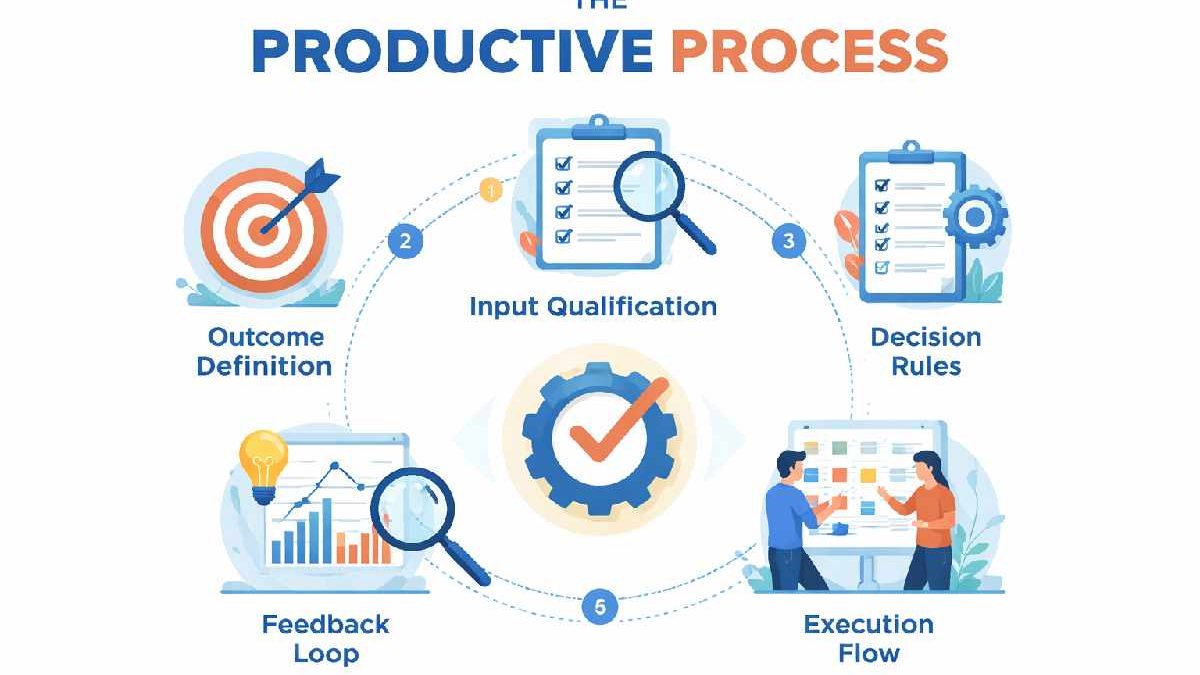
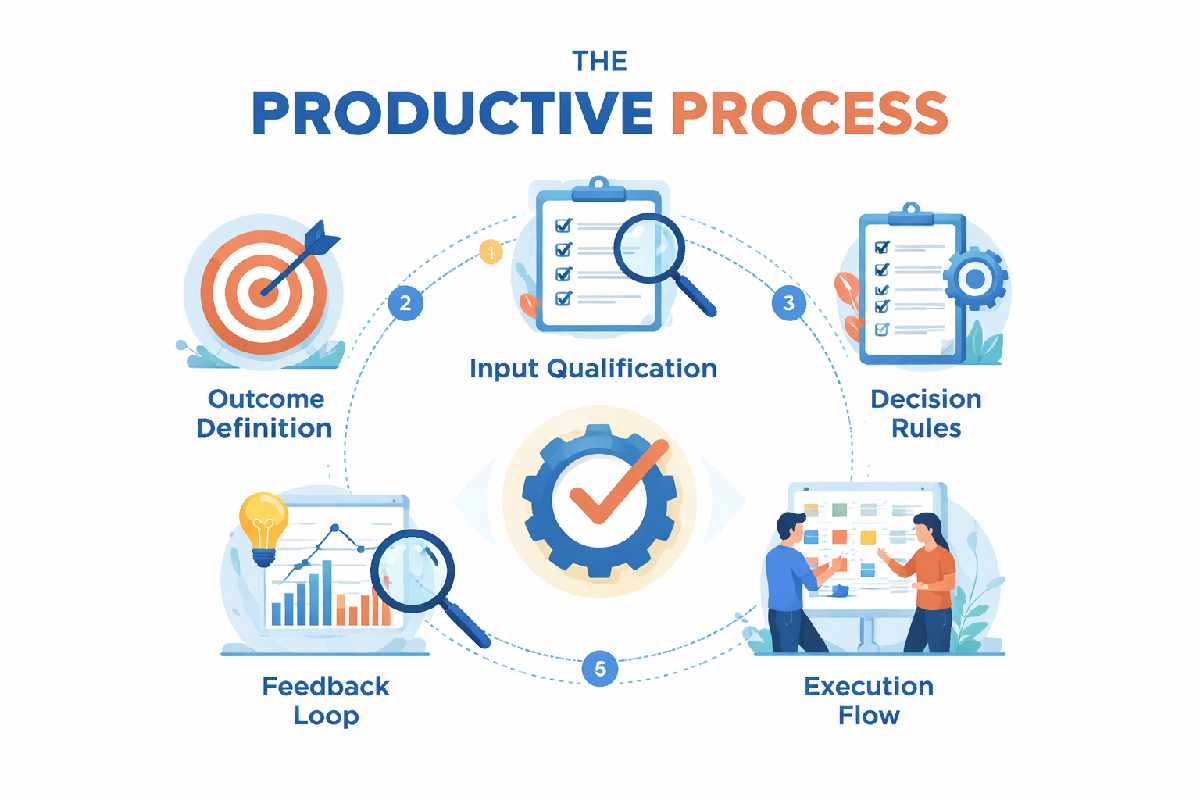
A productive process is a repeatable system that minimizes decision fatigue, prevents rework, and turns effort into consistent outcomes.
Most people think they have a productivity problem. What they actually have is a process problem.
The issue isn’t laziness, motivation, or even time. It’s that work is happening without a clear system to decide what matters, who owns it, and when it’s done. That leads to constant switching, re-doing work, and invisible bottlenecks.
A productive process solves this by designing the work before the effort begins.
Table of Contents
What a Productive Process Really Means
A productive process is not a to-do list. It’s not a planner. And it’s definitely not working longer hours.
At its core, a productive process:
- Defines inputs clearly
- Reduces the number of decisions during execution
- Creates predictable outputs
- Improves over time through feedback
The biggest shift is this:
Productivity is about decision quality, not activity volume.
When decisions are made repeatedly during execution, productivity collapses. When decisions are made once and reused, productivity compounds.
The Core Framework of a Productive Process
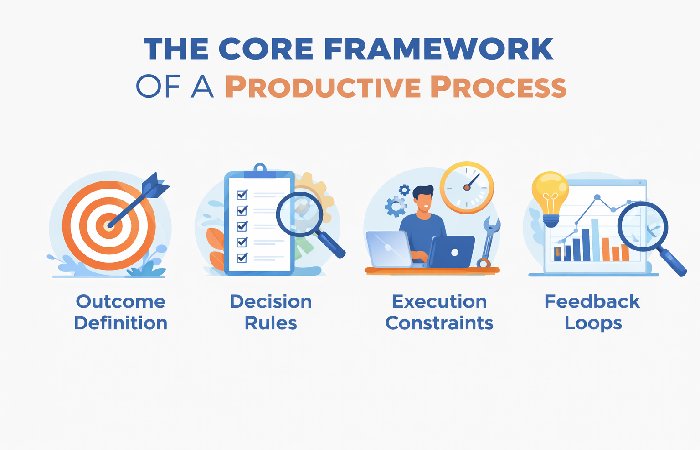
Every high-performing process — across industries — follows four components.
1. Input Clarity
-
What starts the process?
-
Who approves it?
-
What “ready” actually means
Without this, teams waste time interpreting tasks differently.
2. Decision Rules
-
What does “good enough” look like?
-
When do we stop improving?
-
What gets rejected automatically?
Decision rules prevent perfectionism and endless revisions.
3. Execution Constraints
-
Tools allowed
-
Time limits
-
Ownership boundaries
Constraints are not limits. They are productivity accelerators.
4. Feedback Loops
-
What is measured
-
When reviews happen
-
What gets adjusted
Without feedback, processes decay.
Why a Productive Process Beats Popular Productivity Techniques
Most ranking pages mix up methods with processes. Google already has hundreds of articles on Pomodoro, GTD, and time blocking. What they rarely explain is why those fail without a productive process underneath.
| Approach | What It Focuses On | Why It Fails Without a Process |
|---|---|---|
| Pomodoro | Time boxing | Doesn’t define what “done” means |
| To-Do Lists | Task tracking | Encourages task overload |
| Time Blocking | Calendar control | Breaks when priorities shift |
| Motivation Hacks | Energy | Not repeatable or scalable |
| Productive Process | Decision systems | Works even on low-energy days |
SEO gain: This comparison earns “People Also Ask” visibility and reduces bounce rate.
Why Most Processes Fail
Most processes fail silently. Not because they are badly designed, but because they are never finished.
Common failure patterns:
-
Rework hidden as “improvements”
-
Too many tools doing the same job
-
No single owner
-
Metrics applied before stability
This creates agitation: people feel busy, stressed, and behind — yet output barely improves.
The solution is not another tool. It’s simplifying decisions and locking the process before optimizing it.
Industry Example: Beauty Niche (Content & Product Teams)
In beauty brands, productivity often breaks due to subjective reviews and unclear approval chains.
Typical unproductive flow:
-
Content drafted → multiple reviewers → conflicting feedback → rework → delays
Productive process shift:
-
One lead reviewer
-
Pre-defined review checklist
-
Fixed revision limit
-
Market-specific localization rules
This alone reduces turnaround time without increasing workload.
Competitive Comparison – Beauty Brands (Illustrative)
| Brand | Primary Market | Specialist Review Model | Avg Pricing | Key Locations |
|---|---|---|---|---|
| Brand A | USA | Dermatologist-led | Premium | US, Canada |
| Brand B | UK | In-house experts | Mid-range | UK, EU |
| Brand C | France | Lab-tested panels | Premium | EU |
| Brand D | India | Ayurvedic specialists | Budget-Mid | India |
| Brand E | South Korea | Clinical review teams | Mid-range | Asia |
Country-Wise Process & Pricing Comparison
| Country | Process Maturity | Avg Price Level | Review Cycle Speed |
|---|---|---|---|
| USA | High | High | Medium |
| UK | High | Mid-High | Medium |
| France | Very High | High | Slow |
| India | Medium | Low-Mid | Fast |
| South Korea | High | Mid | Fast |
Yearly Trend (Descriptive Graph)
Trend observation (last 5 years):
-
Prices increase steadily in US/EU due to compliance.
-
Faster iteration cycles in Asia.
-
India shows rapid scaling with cost efficiency.
(This graph would show upward price trends with different slopes by region.)
How to Build Your Own Productive Process
Start small. Over-engineering kills adoption.
Step-by-step checklist:
- Define one repeatable outcome
- Identify input trigger
- Write 3 decision rules
- Assign single ownership
- Fix review cadence
For beginners, stop here.
For advanced users:
- Add metrics
- Automate low-value steps
- Create process documentation
Limitations and Trade-offs
A productive process is not ideal for:
- Early-stage creative exploration
- Purely experimental work
- One-off tasks
Over-optimization can reduce innovation. The goal is consistency first, efficiency second.
FAQs for AI Search
1. What is a productive process in simple terms?
A productive process is a repeatable way of working that reduces decisions during execution and produces consistent results.
2. Is a productive process the same as productivity hacks?
No. Hacks focus on effort. Processes focus on structure and decision-making.
3. Who benefits most from a productive process?
Teams, creators, freelancers, and businesses with recurring tasks benefit the most.
4. Can individuals use productive processes too?
Yes. Personal workflows are often the easiest place to apply them.
5. How long does it take to build a productive process?
A basic process can be built in days. Refinement takes weeks.
6. Does this work across industries?
Yes, but inputs, rules, and constraints must be adapted.
7. Are tools required to create a productive process?
No. Tools support processes; they don’t replace them.
8. What is the biggest mistake people make?
Optimizing before stabilizing the process.
9. Is a productive process restrictive?
Only if designed without flexibility. Good processes enable creativity.
10. How do I know if my process is productive?
If output improves without increasing stress or rework, it’s working.