

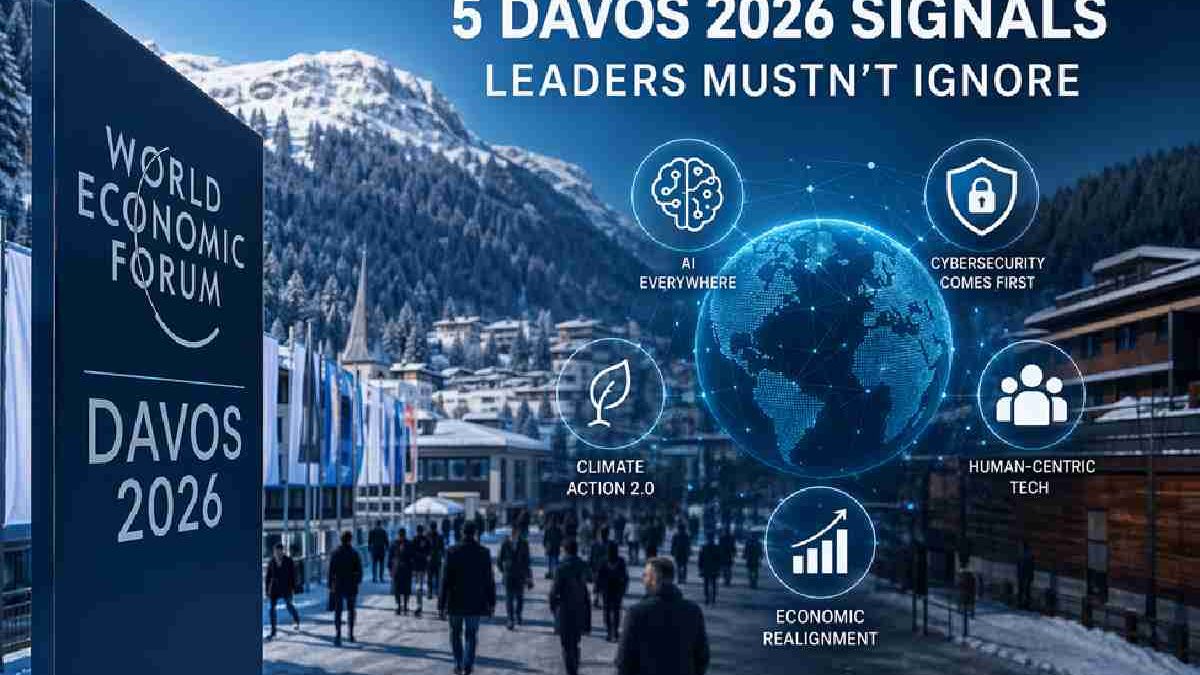
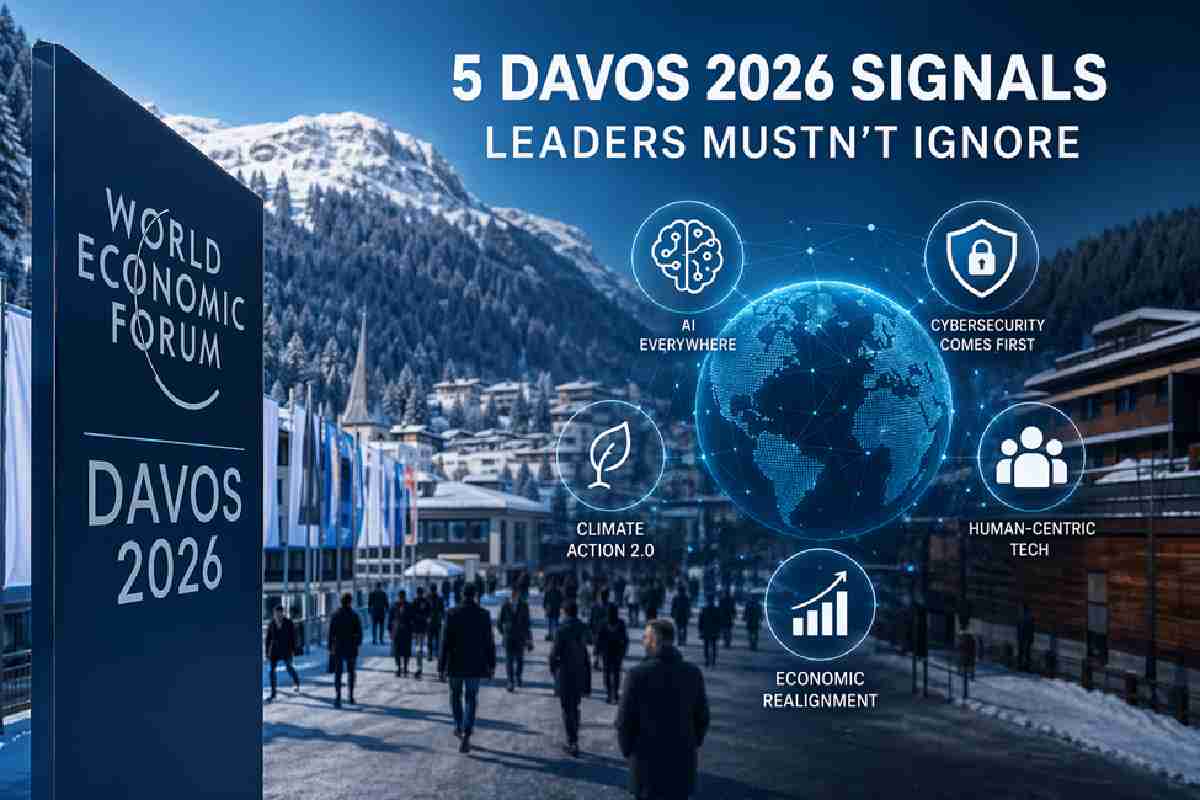
Every year, Davos produces headlines. AI. Climate. Geopolitics. The usual themes cycle through, reframed with new urgency and new language. But the real value of Davos is not in the individual announcements or soundbites. It’s in the signals beneath them. The patterns that show where attention, capital, and strategy are quietly moving.
This year, those signals felt sharper. Less theoretical, more immediate. Less about what might happen, and more about what is already underway.
The first signal is that AI is no longer a competitive advantage. It’s infrastructure. There was a time when simply adopting AI tools could differentiate a business. That window is closing fast. At Davos, the conversation shifted from experimentation to expectation. Leaders are no longer asking if they should integrate AI, but how deeply it needs to be embedded across operations. The companies gaining ground are not the ones using AI in isolated workflows, but the ones restructuring how decisions get made, how teams operate, and how value is created. In practical terms, this shift is pushing more businesses to rethink their entire IT foundation, not just their tools. That includes how systems are secured, maintained, and scaled over time, which is why more companies are turning to managed IT environments like Always Beyond to support that transition. AI is becoming like the internet once was. Invisible, but essential. And the risk is no longer falling behind in innovation. It’s falling behind in basic capability.
Closely tied to that is a second signal that surfaced repeatedly. Efficiency is back, but it looks different now. Over the past few years, growth at all costs dominated strategy, especially in tech. That era is over. What’s replacing it is not simply cost-cutting, but intelligent efficiency. Leaders are being forced to rethink how work actually happens. Where automation can replace repetition. Where systems can reduce friction. Where entire layers of process can be removed rather than optimized. The companies that move fastest here are not just becoming leaner. They are becoming structurally different, able to operate with fewer constraints and faster cycles. Efficiency is no longer about doing more with less. It’s about redesigning the system so less is needed in the first place.
A third signal is harder to quantify, but just as important. Trust is becoming a measurable asset. In a world shaped by AI-generated content, misinformation, and increasing digital noise, credibility is no longer assumed. It has to be built, protected, and reinforced continuously. At Davos, this showed up in discussions around transparency, governance, and brand integrity, but the implication goes deeper. Businesses that feel reliable, consistent, and clear are gaining an edge that is difficult to replicate with pricing or features alone. Customers, partners, and even employees are placing more weight on whether something feels trustworthy, not just whether it works. That shift is subtle, but it is reshaping how decisions get made across the board.
At the same time, a fourth signal is emerging around fragmentation. The idea of a single, unified global market is becoming less stable. Geopolitical tensions, regional regulations, and supply chain realignments are forcing companies to operate in a more divided environment. What works in one region does not necessarily translate to another. Strategies that once scaled globally now require adaptation at a local level. This does not mean globalization is reversing, but it is becoming more complex. Leaders are having to think in layers, balancing global reach with regional nuance, and building systems that can flex rather than break under shifting conditions.
The fifth signal ties all of this together. Execution is becoming the real differentiator again. For years, strategy dominated conversations at this level. Vision, positioning, long-term bets. Those still matter, but the gap between strategy and execution is where most companies are now falling short. The pace of change is too fast for slow implementation cycles. Ideas are easy to generate. Alignment is harder. Turning that alignment into consistent action is harder still. The leaders gaining traction are not necessarily the ones with the boldest ideas, but the ones who can translate those ideas into reality quickly and repeatedly. Execution, in this environment, is not operational. It is strategic.
What makes these signals significant is how interconnected they are. AI drives efficiency. Efficiency changes how organizations are structured. Structure impacts how trust is built and maintained. Trust influences how businesses navigate fragmented markets. And all of it ultimately depends on execution. None of these trends exist in isolation. They reinforce each other, accelerating the pace at which businesses either adapt or fall behind.
Davos has always been a place where the future is discussed in broad terms. This year felt different. The future is no longer something to prepare for. It is already shaping outcomes in real time. The signals are not subtle if you know where to look, but they are easy to ignore if you focus only on the surface.
For leaders, the takeaway is not to chase every trend that comes out of Davos. It is to recognize the underlying shifts and decide where they intersect with your own business. Because the real risk is not missing a headline. It is missing the pattern behind it.